
What is a Digital Twin?
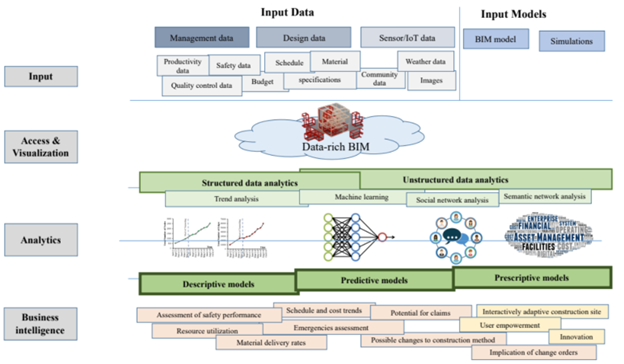
A Digital Twin (DT) is meant to be the twin of a building in the virtual world. In addition to all building data, in order for the DT to be a twin, it should encompass three types of models, descriptive, predictive, and prescriptive.
- Descriptive models: These models attempt to use facility data to understand the ongoing conditions of a facility. These models are developed based on pre-defined theories where the interplay between datasets are used to deduct a holistic picture of what is going on in a building or with an asset. For example, a DT can collate BIM and facility data to generate an energy model for building utilities or calculate its carbon footprints.
- Predictive models: These models use Artificial Intelligence tools to predict what will/can happen with the existing conditions of a building/asset. For example, cost trends and expected budget overruns; productivity patterns; detecting safety-sensitive tasks and situations.
- Prescriptive Models: Prescriptive models are where a DT shifts from visualization to virtualization. These models aim to experiment with potential scenarios in the virtual world before implementing them in the real world and therefore, answer questions like 'what will happen if' or 'what can be done'. For example, replicating maintenance policies under new assumptions or revised technical architecture, or the addition of new equipment.
- Generative Models: Prescriptive DT engages stakeholders in co-imagining futures. Prescriptive DTs can also be generated by computers, where we can realize options that are unseen, unimaginable or more efficient. Thanks to increasing adoption of process-aware information systems, Generative Design Workflow (GDW) is even more promising. It can generate workflows that examine new decision criteria or actor roles; support adaptive tasking. Instead of using DT to provide reactive information on facility management issue, GDW can generate/imagine new workflows that integrate business intelligence in decision making.
Why we need digital twinning?
Advancing the building industry practices in Canada has extensive potential. First, the stakes are high: for example, Canada has over 400,000 institutional buildings, accounting for 18% of emissions. The Federal Government only is spending up to $3 billion for retrofits. Second, the gap in AM systems abilities is big. As a case in point, in 2012-2018 and despite substantial investments in water systems AM tools, the watermain break rates in North America increased by 27% [1]. The social costs can be as high as 400% of construction costs [2]. Third, the rewards are big. Proactive maintenance is 12-18% cheaper than reactive maintenance [3]. The financial ROI on timely decisions is estimated at 20% annually [4].
To conduct the much-needed rehabilitation of our buildings, we have to generate new knowledge and re-develop decision systems in the sector. The sector relies on rules of thumb (the famous 2-4% annual investment target) or standard formulae, such as the omnibus deterioration curve. With outdated tools, a decision maker has to consider a complex set of goals: levels of services (LOS), energy saving, climate impacts. In fact, based on a study by the Federal Reserve Bank of New York, over the last four decades all industries have achieved gains in their productivity, except the construction industry.
We need new tools. We also need to update the existing expert-based mentality with one of learning from real-world practice. By virtualizing futures, DT support choosing the right project: study the impact of project on tangible (i.e. built assets) or intangible (environmental and social) systems over their life cycle. DT also helps build the project right. By pooling expertise of all stakeholders and with insights from ML, we can improve safety, productivity and reduce delays and costs.
The Opportunity with UofT's Digital Twins
The unprecedented dataset of 150 buildings allows us to explore approaches that rely on data analytics and machine learning (ML). This can lead to a breakthrough in informatics research in the domain, which has been dominated by normative thinking. The following features make our dataset unique:
- Data triangulation: longitudinal structured data (e.g. IoT data), unstructured data (e.g. complaints, and maintenance logs), and building contextual data (e.g. weather and community profile).
- Data reliability: The engagement of facility operators will provide researchers with a "ground truth” view of data, which can help overcome data reliability and completeness issues.
- Higher-value data: providing access to the data for other colleagues who work on topics such as energy, air quality will generate new sets of insightful data (simulations of possible scenarios).
- Occupants & their data: For long, informatics research in the domain has focused on professionals. The Center will have access to the (typically illusive) occupant data; and to occupants themselves (innovative stakeholders with unique knowledge profiles, who can create ideas/new apps).
Second, (the push of) industrial need. There is an increasing demand for advanced data analytics in buildings. For example, large buildings are required to report electricity, water, and gas use. There is an awareness that data-driven tools are needed to conduct such analysis and make the right decisions.
Third, the (pull of the) success of AI in other sectors. Key firms in the filed recognize that investments in data management are not just good engineering practices, it is an essential tool for market survival.